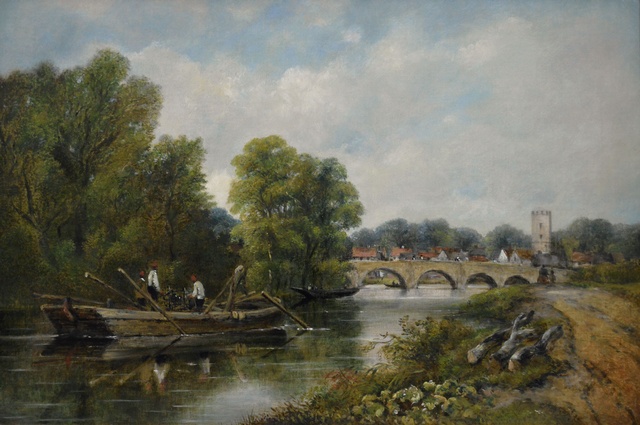
Frederick Waters Watts
British, (1800-1870)Aylesford Bridge, Kent
Oil on canvas, stencil mark to the stretcher
Provenance: Christie’s Fine Victorian Pictures, 31 October 1986, lot 38.
A fine painting of figures on a boat near Aylesford Bridge by Frederick Waters Watts. To the left of the painting, a wooden boat with a winch is shown moored by the side of the river Medway with three figures aboard. Meanwhile other boats are depicted further along towards the bridge, as figures on horseback travel along the opposite bank. In the distance to the right, can be seen the tower of St Peter and St Paul’s church with a row of alms houses and other buildings in front of it. Although this painting is unsigned, which was not unusual for Watt’s, it bears all the hallmarks of his distinctive style and subject matter; from the colour palette used to the treatment of the figures, water and trees, as well as the draughtsmanship of the boat and buildings.
At some point, the original title of the painting was lost, however, careful investigation has identified the location as being Aylesford Bridge in Kent. Further research has also revealed that Watts exhibited a work entitled ‘Aylesford Bridge’ at the British Institution in 1826, no. 20, together with two other views of the area. The size of the work listed, which would have included a frame, is strikingly similar to this painting. A work with the same title was later exhibited at the RA in 1835, no. 670. Many of his paintings at the RA were previously exhibited elsewhere, often several years prior, which would strongly indicate that the two works are one in the same. The reverse of the painting bears Christie’s marks and stencil from the Fine Victorian Pictures sale on 31 October 1986, lot 38, where it was catalogued as Frederick Waters Watts.
Frederick Waters Watts was born in St Albans on 7 October 1800, the son of William Watts and his wife Mary (née Eyre). He was christened Frederick Waters Watts, a name which would become particularly fitting in his ensuing career. His father was a landowner from Hoxton and his mother was the daughter of the Reverend Ambrose Eyre of Cambridge. Although little is known about his early life, his father’s income would have meant he received a good education. In 1817, at the age of 17 he enrolled at the Royal Academy under the name William Watts. He later reverted back to his full name, most likely to avoid confusion with the artist and engraver William Watts (1752-1851).
During his time at the RA schools, he won a number of silver medals and began exhibiting at the RA exhibitions in 1821. By this point, he was living in Hampstead High Street from where he started exhibiting at the British Institution from 1823 and Royal Society of British Artists from 1825. He was greatly influenced by Constable who also resided in Hampstead; although there is no evidence they ever met. The vast majority of his subject matter was of landscapes and many of his paintings featured rivers and bridges, such as this fine example. He travelled widely throughout the UK and is known to have visited Wales, Herefordshire, Devon, Kent, Hampshire and Scotland. In 1827 he travelled to France where he spent time in Rouen.
Watts married Jane Dorothy Gibbon on 28 April, 1836 at St Pancras Old Church, London. The couple made their home at 6 Union Terrace in Hampstead where their son Frederick Hase Watts was born. By 1838, he had moved to 1 Haverstock Terrace where he was to spend the next 30 years. After his father’s death in 1851, he inherited all of his father’s property and wealth. From his base in Hampstead he continued travelling around the country, often painting a number of different views of the areas he visited.
His first wife Jane died in 1853 and in 1857 he married Juliana Joanna Louisa Grimwood. The couple had two children and lived with his son from his first marriage. Sometime towards the end of the 1860’s Watts made his final move to Lawn Road in Hampstead where he died on 4 July, 1870. His work is held in numerous public collections including the Ashmolean Museum, Chepstow Museum, Government Art Collection, Maidstone Museum, Museum of London, National Trust, River & Rowing Museum, Royal Society of Arts, Shipley Art Gallery, Southampton City Art Gallery, Towneley Hall Art Gallery, V&A, Walker Art Gallery and Williamson Art Gallery.
© Benton Fine Art
| Presentation | The work is housed in a new, English made gilt frame which is in excellent condition. |
| Condition | As with all of our original antique oil paintings, this work is offered in ready to hang gallery condition, having been professionally cleaned, restored and revarnished. |
| Image Size | 19.5 inches x 29.25 inches (49.5cm x 74.5cm) |
| Framed Size | 25.5 inches x 35.25 inches (65cm x 89.5cm) |